If you’ve ever worn progressive glasses and felt like something was “off,” the problem probably wasn’t your prescription. It was likely how the glasses were fitted to your face. The fitting process determines exactly where your eyes line up with each zone of the lens. A small error, and you get headaches, blurred edges, or dizziness.
This is where the debate between the old manual method and the AI-powered ZEISS iTerminal matters. At Jaipur Eye & Dental Hospital, we’ve seen firsthand how upgrading from a ruler to digital centration changes the patient experience entirely.
Why Fitting Matters More Than You Think
Progressive lenses have three distinct zones: distance (top), intermediate (middle), and near (bottom). Your eyes must align precisely with each zone for the glasses to work correctly. If the fitting height is off by even 1mm, you could be looking through the reading zone when you’re trying to drive.
A 2023 study published in PLoS One found that about 57% of single-vision glasses wearers were not looking through the optical center of their lenses, experiencing unwanted prismatic effects as a result (Madrolu et al., 2023). With progressive lenses, the problem is amplified because the corridor between zones is narrow.
The practical impact? Around 25% of first-time progressive lens wearers abandon their glasses within the first year, and poor fitting is the leading cause, not the prescription itself.
How Does the Old Manual Method Work?
The manual method has been the standard for decades. An optician uses a ruler or PD stick to measure your pupillary distance (the distance between your pupils). They mark the fitting height on the demo lenses of your chosen frame using a felt-tip pen. That’s essentially it.
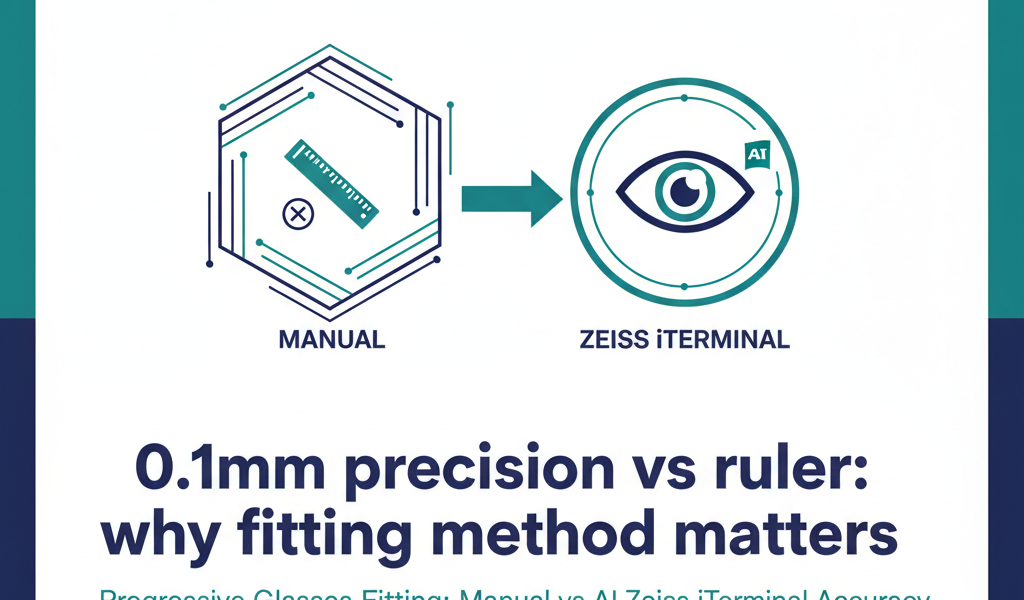
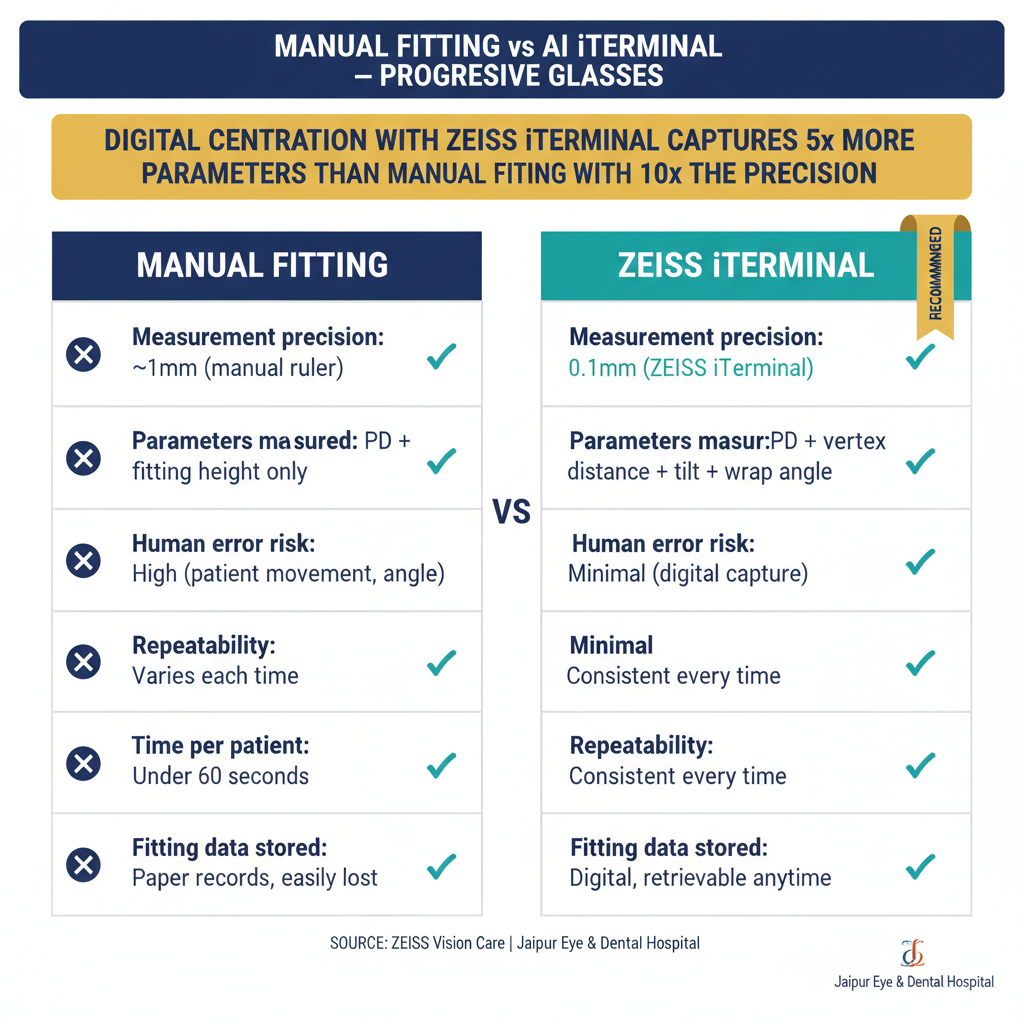
The process captures two data points: PD and fitting height. And while an experienced optician can get reasonably close, the method has clear limitations. Patient movement, parallax error (the angle from which you’re looking at the ruler), and the thickness of the frame can all throw off measurements. Typical manual precision is around 1mm, which sounds small but is significant for progressive lenses.
Manual methods also cannot measure how the frame sits dynamically on your face. They miss three critical parameters that affect lens performance: vertex distance (how far the lens sits from your eye), pantoscopic tilt (the angle of the frame relative to your face), and wrap angle (how much the frame curves around your temples).
What Makes the ZEISS iTerminal Different?
The ZEISS iTerminal is a digital centration system that uses a high-resolution camera and advanced software to capture your exact facial and frame measurements in a single click. The precision is 0.1mm, which is 10 times finer than manual methods.
Here’s what it measures that manual methods cannot:
- Pupillary distance (PD) with sub-millimeter accuracy
- Fitting height for each eye independently
- Back vertex distance (BVD), the space between your cornea and the back of the lens
- Pantoscopic tilt, the downward angle of the frame on your face
- Wrap angle, how much the frame curves around your temples
These five parameters are sent directly to the ZEISS lens manufacturing lab, where your lenses are personalized to match your exact wearing position. The entire measurement takes under 60 seconds per patient, compared to 5-10 minutes for a manual fitting.
Manual vs AI: Which Should You Choose?
For standard single-vision glasses, manual fitting works fine for most people. The tolerance is wider, and small errors are less noticeable. But for progressive lenses, the margin for error is narrow. The more personalized the lens design, the more accurate the measurements need to be.
The ZEISS iTerminal becomes essential if you’re getting premium progressive lenses like ZEISS Individual or ZEISS Progressive Individual, which are specifically designed to account for your exact wearing position. Using a manual method with these lenses defeats the purpose of buying a personalized product.
What Happens When Your Glasses Are Poorly Fitted?
The symptoms of a bad progressive lens fitting are surprisingly specific. You might feel fine looking straight ahead but notice blurriness or a “swimming” sensation when you turn your head. Reading might feel uncomfortable even though your near power is correct. Some patients report dizziness, nausea, or simply never adapting to their new glasses.
Rather than assuming the prescription is wrong, the first step should always be to recheck the fitting. A 2024 industry analysis found that the return rate for progressive lenses was around 5% when ordered online (where fitting is often self-measured), compared to under 1% when dispensed in-person with proper centration equipment (Eyeglasses.com, 2024).
Frequently Asked Questions
Can I reuse my old fitting measurements for a new frame?
No. Each frame sits differently on your face. Changing the frame changes the vertex distance, tilt, and wrap angle. You need fresh measurements every time you switch frames, especially with progressive lenses.
Is digital centration worth it for simple reading glasses?
For basic single-vision reading glasses, manual fitting is usually sufficient. Digital centration matters most for progressive lenses, high prescriptions, and premium personalized lens designs where the fitting parameters directly affect optical performance.
Does the ZEISS iTerminal work with any frame brand?
Yes. The iTerminal can measure any frame, regardless of brand or material. It works with full-rim, half-rim, and rimless frames. The only requirement is that the patient can sit still for the brief capture moment.