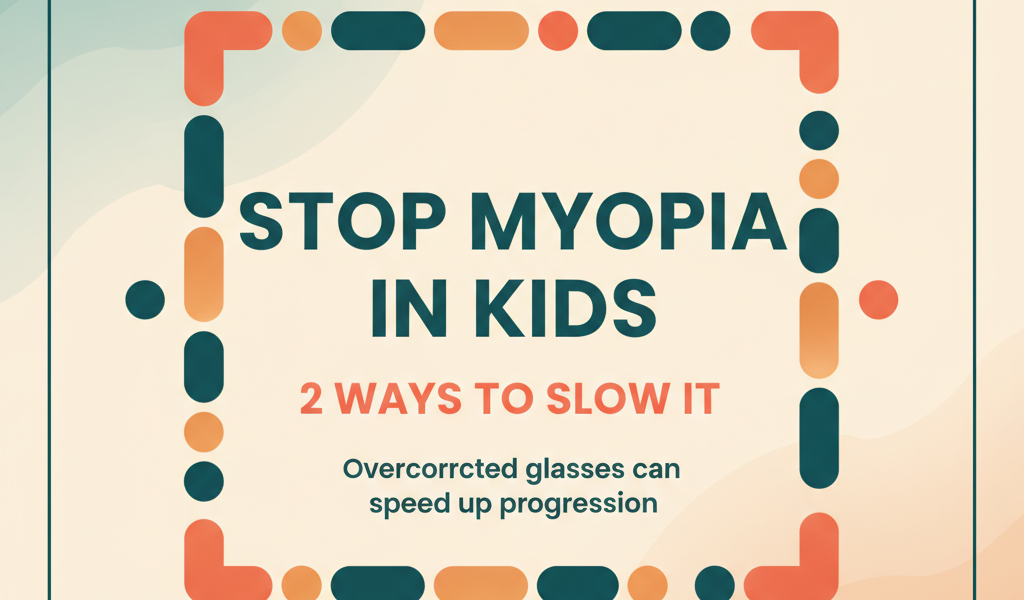
Is your child’s eye power going up every few months? You’re not alone. Myopia (nearsightedness) in children is rising fast across India, and one hidden cause might be sitting right on their face: overcorrected glasses.
At Jaipur Eye & Dental Hospital, we regularly see child patients who come in with headaches and fatigue. Often, the root cause is glasses that are too strong for their actual power. Here’s what parents need to know, and two proven ways to slow myopia from getting worse.
Can Overcorrected Glasses Increase Myopia in Children?
Yes, they can. When a child wears glasses with a power higher than what they actually need, their eyes are forced to over-focus constantly. This sustained near-work strain sends signals to the eye that accelerate axial length growth — which is exactly what drives myopia progression ([MyopiaProfile], 2021).
In our practice at JEDH, we’ve seen children whose number jumped significantly within months of getting new glasses from an optical shop without a proper clinical refraction. Symptoms often include frequent headaches, eye rubbing, reluctance to read, and tired eyes by evening.
Research published in Ophthalmic and Physiological Optics found that under-corrected and overcorrected glasses both contribute to faster myopia progression compared to accurate prescriptions ([PMC], 2023). The takeaway is clear: your child’s glasses must match their exact power, and that requires a proper eye examination by a qualified ophthalmologist — not just a reading test at a shop.
Low-Dose Atropine Drops — How Do They Work?
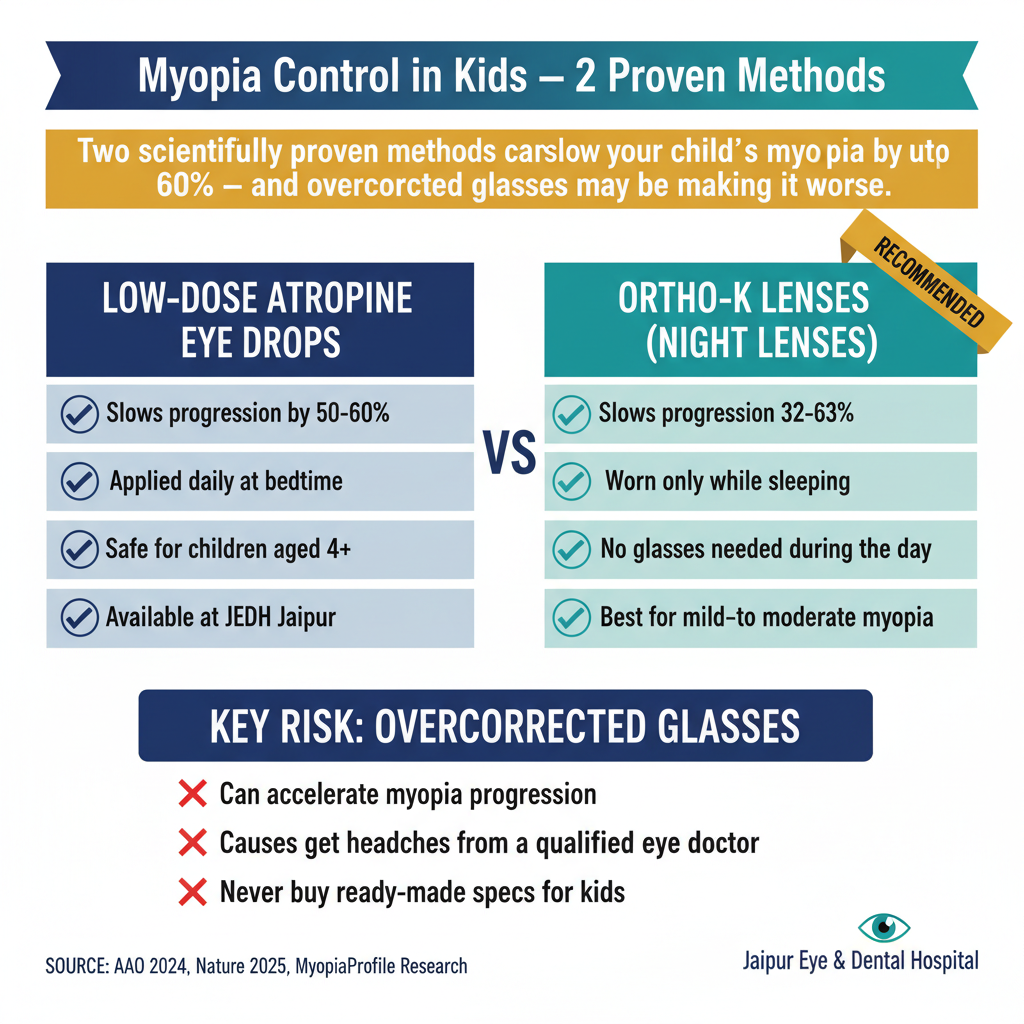
Low-dose atropine (0.01% to 0.05%) eye drops, applied once daily at bedtime, can slow myopia progression by 50–60% over 2–3 years of use ([AAO], 2024). They work by mildly relaxing the focusing muscle inside the eye, which reduces the signal that causes the eyeball to elongate.
These drops are safe for children aged 4 and above, cause minimal side effects at low concentrations, and don’t affect your child’s vision during the day. At JEDH, we prescribe low-dose atropine as a first-line treatment for children whose myopia is progressing faster than 0.50 diopters per year.
Multiple large-scale studies, including the landmark ATOM and LAMP trials, have confirmed that 0.01% atropine provides effective myopia control with an excellent safety profile ([Nature], 2025).
Ortho-K Lenses — Wear at Night, See Clearly All Day
Orthokeratology (Ortho-K) lenses are specially designed rigid contact lenses that your child wears only while sleeping. They gently reshape the front surface of the cornea overnight, so your child can see clearly during the day — without glasses or contact lenses.
More importantly, Ortho-K has been shown to slow myopia progression by 32–63% ([Nature], 2025). The peripheral defocus created by the reshaped cornea is believed to be the mechanism that slows axial elongation of the eye.
Ortho-K works best for children with mild to moderate myopia (typically up to -4.00 or -5.00 diopters). It requires careful fitting by an experienced eye care professional and regular follow-up visits. At Jaipur Eye & Dental Hospital, we assess each child’s suitability based on their corneal topography, power, and lifestyle before recommending Ortho-K.
When Should You Take Your Child for an Eye Check?
If your child is squinting at the TV, sitting too close to screens, complaining of headaches, or their teacher reports difficulty seeing the board, schedule an eye examination immediately. Early detection is critical — the younger the child when myopia starts, the faster it tends to progress.
We recommend a comprehensive eye check at age 3–4, and then annually once glasses are prescribed. Don’t rely solely on school vision screenings, which often miss astigmatism and binocular vision problems.
Frequently Asked Questions
Can my child’s myopia be reversed completely?
No. Myopia cannot be reversed once the eyeball has elongated. However, myopia control treatments like atropine drops and Ortho-K lenses can significantly slow down its progression, preventing it from reaching dangerous levels that increase the risk of retinal detachment and glaucoma later in life.
Are atropine eye drops safe for long-term use in children?
Yes. Low-dose atropine (0.01%) has been studied extensively over 2–3 year periods and is considered safe for children aged 4 and above. Side effects are minimal — mild light sensitivity and near blur are rare at this concentration and resolve quickly.
What age is too late for myopia control?
Myopia typically stabilizes by age 18–21, but the most critical window for intervention is between ages 6 and 14, when progression is fastest. Starting treatment earlier yields better outcomes, but teenagers can still benefit significantly from myopia control measures.
Call +91 7976551251 or visit
jaipureyedental.com to book a comprehensive eye check-up with Dr. Amit Gupta at Jaipur Eye & Dental Hospital.