Why the Fitting Method Matters More Than You Think
Getting progressive glasses isn’t just about choosing the right lens power. The way those lenses sit on your face determines whether you see clearly at every distance or spend weeks struggling with headaches and dizziness. At Jaipur Eye & Dental Hospital, we’ve seen hundreds of patients who got progressive glasses elsewhere but couldn’t adapt, only to discover the problem wasn’t their lenses — it was how they were measured.
What Is the Traditional Manual Fitting Method?
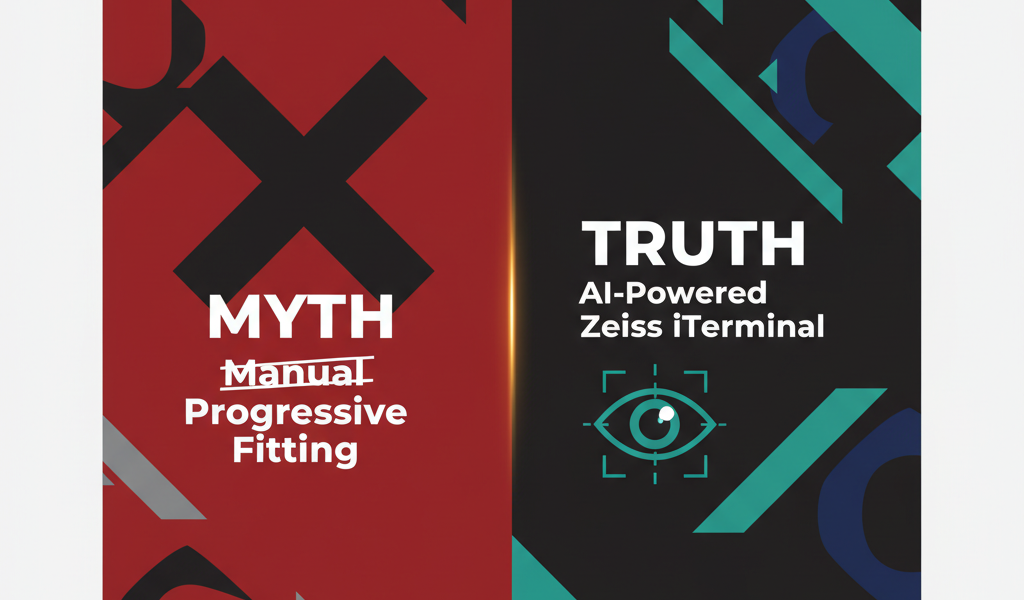
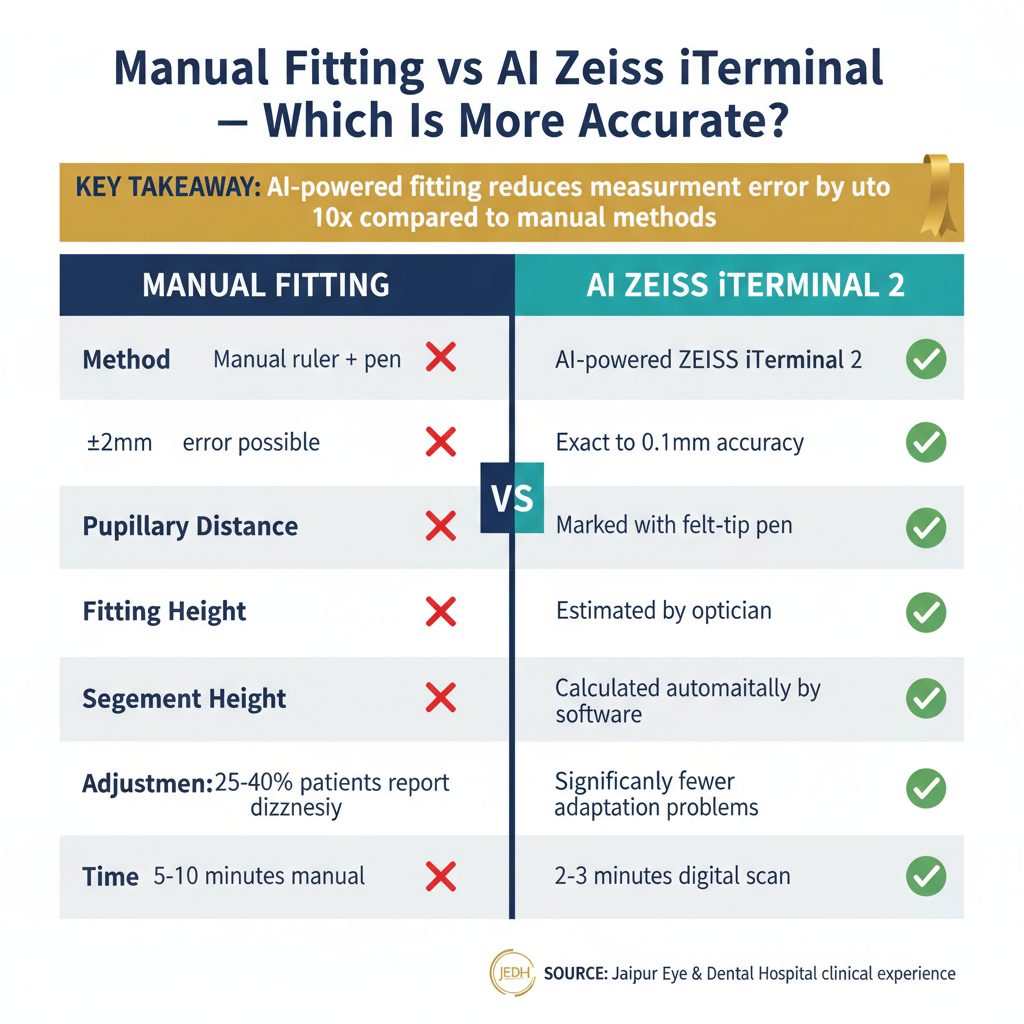
For decades, progressive glasses were fitted using a simple setup: a ruler and a felt-tip pen. The optician would physically mark your pupil centre on the frame, measure the distance between your pupils (pupillary distance or PD) by hand, and estimate the fitting height by eye.
The problem? This process is inherently imprecise. According to industry data, manual PD measurement can have an error range of ±2mm or more ([ZEISS Vision Care], 2023). That might sound small, but with progressive lenses, even a 1mm shift in the optical centre can cause noticeable peripheral blur and discomfort.
Common complaints from patients fitted with the manual method include dizziness while walking, nausea when looking down, and difficulty transitioning between near and far vision zones ([NVision Eye Centers], 2023). Many patients simply stop wearing their progressives because the adaptation period feels unbearable.
How Does the ZEISS iTerminal 2 Work?
The ZEISS iTerminal 2 replaces the ruler and pen with a digital 3D measurement system. Here’s what happens during your fitting at our hospital:
You put on your chosen frame. The iTerminal captures a high-resolution image of your face through the lenses. Its software automatically detects your pupils, measures the exact PD, and calculates the centration and fitting height in seconds.
No felt-tip pen on your frame. No guesswork. No manual calculations. The system delivers measurements accurate to 0.1mm, which is roughly 10 times more precise than what a ruler can achieve ([ZEISS i.Terminal 2 Technical Data], 2023).
A proper centration report is then generated and sent directly to the lab. Your progressive lenses are manufactured to match your exact facial anatomy, your natural head posture, and how you actually wear the frame — not some averaged measurement.
Why Does Measurement Accuracy Actually Matter?
Progressive lenses have three zones: distance, intermediate, and near. Each zone is precisely positioned within the lens. If the lens sits even slightly off-centre, you end up looking through the wrong zone for a given task.
Looking through the reading zone while driving? That’s blurry highway vision. Looking through the distance zone while reading your phone? That’s eye strain and frustration. Studies suggest that 25-40% of patients fitted with manual methods report significant adaptation problems ([Della Optique], 2021). With AI-based fitting, that number drops substantially because the lenses match your actual position.
Your frame’s position on your face matters too. Frames sit differently on everyone — some people’s ears aren’t level, some have a higher bridge. The iTerminal captures all of this, so your lenses are made for your face, not a generic average.
Who Should Get AI-Powered Progressive Fitting?
If you’re 40 or older and need progressive glasses, AI fitting is worth it. But it’s especially important for:
- First-time progressive lens wearers: A better first fit means fewer adaptation issues and a higher chance you’ll actually wear your glasses.
- Previous progressive failures: If you tried progressives before and couldn’t adapt, the problem was likely the fitting, not the lenses.
- High prescriptions or astigmatism: The higher your power, the less room for error. AI precision becomes non-negotiable.
- Computer users: You need the intermediate zone to land exactly where your screen sits. Manual methods often get this wrong.
At JEDH, we use the ZEISS iTerminal 2 for every progressive lens fitting. We believe that if you’re investing in quality progressive lenses, the fitting should match that quality. A great lens with a poor fitting is money wasted.
Frequently Asked Questions
Can progressive glasses cause headaches?
Yes, but usually because of incorrect fitting rather than the lenses themselves. Headaches are one of the most common complaints with progressive glasses, and they almost always trace back to measurement errors in pupillary distance or fitting height ([Lensmart], 2026).
How long does it take to adapt to progressive lenses?
Most patients adapt within 1-2 weeks with properly fitted lenses. With AI-powered fitting like ZEISS iTerminal, the adaptation period is often shorter because the lens zones align correctly from day one.
Is ZEISS iTerminal fitting worth the extra cost?
Considering that measurement errors are the leading cause of progressive lens rejection, yes. The cost of re-making lenses because of a bad fit often exceeds what you’d pay for accurate fitting upfront.
Can I use any frame with AI fitting?
Yes. The ZEISS iTerminal works with virtually any frame. In fact, it captures exactly how the frame sits on your face, so it’s especially useful for frames that don’t sit symmetrically.
Call +91 7976551251 or visit
jaipureyedental.com