If you’ve crossed 40 and your near vision is getting blurry, progressive glasses are probably on your radar. But here’s something most patients don’t think about: the lens power matters, but how precisely the lens is fitted inside your frame matters just as much.
At JEDH, we’ve seen countless patients who got progressive glasses elsewhere and complained about dizziness, blurriness at the sides, or headaches. More often than not, the problem wasn’t the lens — it was the fitting. That’s exactly what Dr. Amit Gupta explains in this video, comparing the old manual method with AI-based ZEISS iTerminal centration.
What Was Wrong With the Old Manual Method?
Until a few years ago, every optician used the same approach to make progressive glasses. They would place the chosen frame on your face, pick up a pen marker, and manually draw dots on the lenses showing where your pupil sits.
Your pupillary distance (PD) was measured with a simple ruler. The fitting height — how high or low your eyes sit in the frame — was eyeballed. There was no precise measurement of how much the frame tilts on your nose (pantoscopic tilt) or wraps around your face (wrap angle).
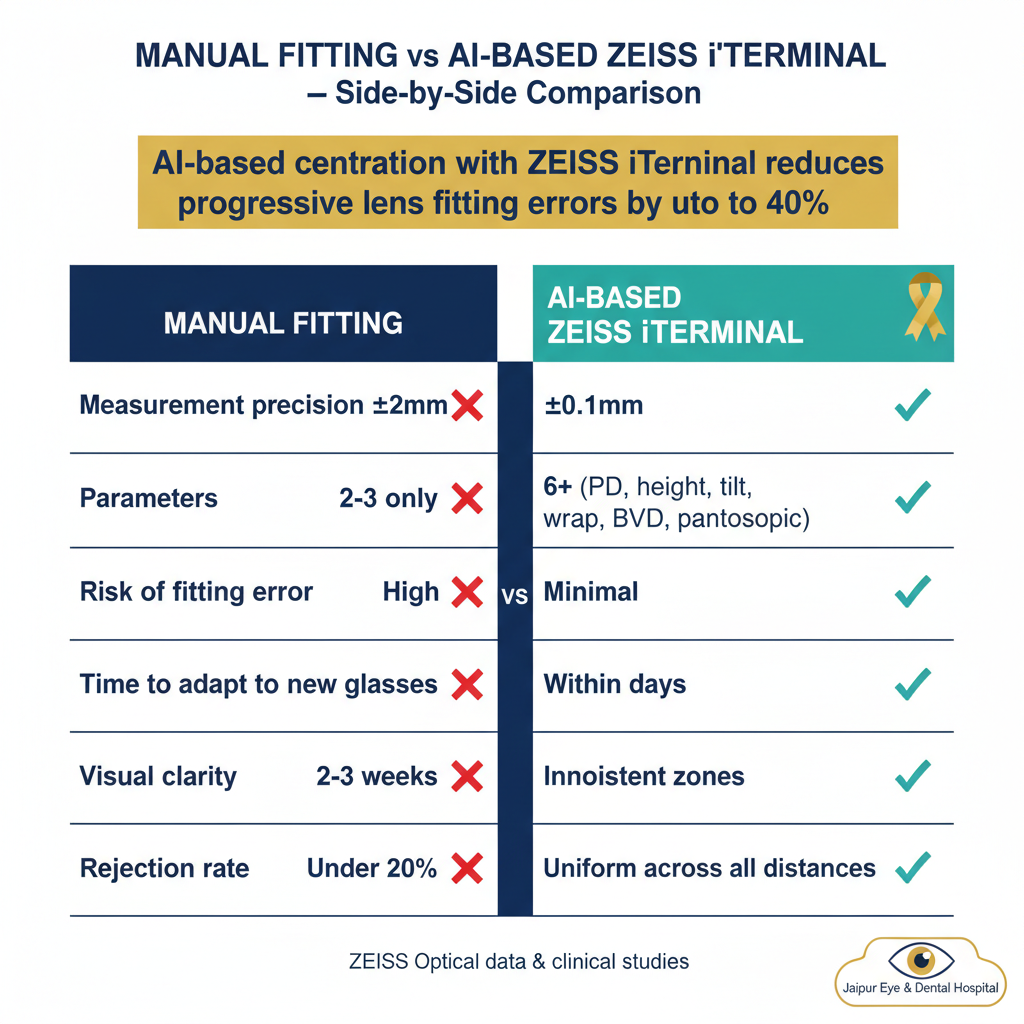
Here’s the problem: even a 1mm shift in the optical centre can cause noticeable blurriness in progressive lenses. With manual marking, the margin of error can be as high as 2mm ([Essilor Professional Resources, 2023](https://www.essilorpro.com)). That doesn’t sound like much until you realise the clear vision corridor in a progressive lens is barely 4-5mm wide. A 2mm error means you’re already at the edge of distortion.
This is why many patients need 2-3 weeks to adapt to new progressive glasses — and some never fully adapt. Studies suggest up to 20% of first-time progressive lens wearers reject their glasses entirely due to fitting issues ([Journal of Optometry, 2025](https://www.journalijdr.com)).
How Does the ZEISS iTerminal Work?
The ZEISS iTerminal is a digital centration device that replaces the manual pen-and-ruler approach with AI-based precision measurement. Here’s what happens when you walk into JEDH for progressive glasses:
Your chosen frame is placed on your face, and the iTerminal’s camera captures a detailed image. The software then measures up to 6 parameters simultaneously — pupillary distance, fitting height, pantoscopic tilt, wrap angle, back vertex distance, and the position of wear — all within 0.1mm accuracy ([ZEISS, 2024](https://www.zeiss.com)).
A proper centration report is generated on the spot, from the same side and from above. This report goes directly to the lens lab, so your progressive lens is manufactured to match your exact frame position on your face. Not an average. Not an estimate. Your actual, measured data.
Does Digital Fitting Really Make a Difference?
Yes, and the data backs it up. ZEISS clinical studies show that digital centration can improve the visual performance of progressive lenses by up to 40% compared to manual methods ([ZEISS i.Terminal Product Data](https://www.youtube.com/watch?v=kKBkQ8k3Fmc)). That’s a significant jump.
Patients fitted with the iTerminal report clearer distance vision, sharper near zones, and smoother transitions between the two. The adaptation period drops from the typical 2-3 weeks down to just a few days. Side vision distortion — the most common complaint with progressive lenses — is noticeably reduced because the lens zones are precisely aligned with how your frame actually sits on your face.
Think of it this way: manual fitting is like getting a tailored suit measured with a measuring tape by someone who’s in a hurry. Digital centration is like a 3D body scan that captures every contour. Both produce a suit, but only one fits perfectly from day one.
Who Should Get AI-Based Progressive Lens Fitting?
If you’re getting progressive lenses for the first time, digital centration should be non-negotiable. First-time wearers already face a learning curve — adding fitting errors to the mix is asking for frustration.
But it’s equally valuable if you’ve had a bad experience with progressive glasses in the past. Many patients who “couldn’t adapt” to progressives were simply wearing improperly fitted lenses. A fresh pair made with iTerminal data often changes their experience entirely.
If you have a high prescription, astigmatism, or need different corrections for each eye, precision matters even more. The smaller the tolerance for error, the bigger the benefit of 0.1mm accuracy.
Frequently Asked Questions
Is the ZEISS iTerminal measurement painful?
Not at all. It’s a simple, non-contact digital scan. The camera captures your frame position on your face — no lasers, no eye drops, no physical contact with your eyes.
How long does the iTerminal measurement take?
The entire process takes about 2-3 minutes. The device captures measurements instantly and generates your centration report on the spot.
Can I use any frame with the iTerminal?
Yes. The iTerminal works with virtually all frame types — full rim, semi-rimless, rimless, and even wraparound frames. The software adjusts for each frame’s unique geometry.
Do I need to visit JEDH for iTerminal fitting, or can any optician do it?
Not every optical shop has invested in the ZEISS iTerminal. At Jaipur Eye & Dental Hospital, we use it as a standard part of our progressive lens dispensing process to ensure every patient gets the most accurate fit possible.
I already have progressive glasses. Should I switch to iTerminal-fitted lenses?
If you’re happy with your current progressive glasses, there’s no need to change. But if you experience headaches, dizziness, or narrow reading zones despite wearing progressives, the fitting — not the lens — is often the culprit. A new pair made with iTerminal data could make a real difference.